Every email passes the same gates, in order.
Riley is in development and has no customers yet.
The design. Being built, not running yet.
-
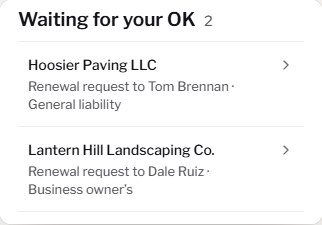
1Drafted
Riley drafts it. Nothing has gone out.
-
2Lawyer gate
No client email before a lawyer's review.
Hard stop -
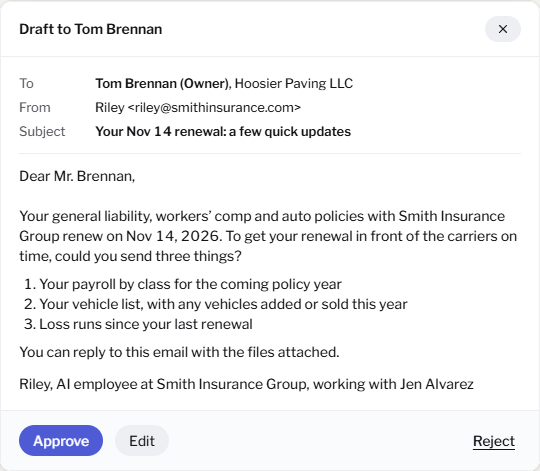
3A person
In training, a person OKs every email.
-
4Safety check
Unsure, or the check can't finish? It waits.
Hard stop -
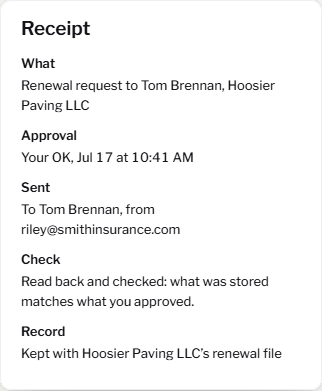
5Sent
Sent, then read back and checked.
-
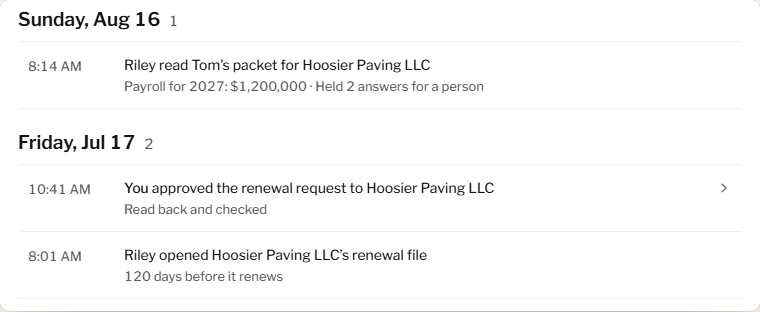
6On record
Who OK'd it, and when, on record.
Not done yet. We'd rather say so.
- SOC 2Not held
- ISO 27001Not held
- Independent security testNot done
Everything not done yet
SOC 2 and ISO 27001
We hold neither today.
None heldIndependent security test
Not doneZero data retention from the AI provider
We're asking our AI provider for this in writing, with a no-training agreement. Until both are in place, we don't send any real agency's data to the AI provider.
Not yetDeleting your data
We plan to delete your data within 90 days of you stopping. The automated deletion job is not built, and how deletion works for the append-only log is still being decided.
Not builtField-level encryption
Sensitive fields rely on the providers' encryption and on each agency being kept apart. Extra encryption is planned, not built.
PlannedPersonal data masked in logs
PlannedSecure upload for sensitive items
PlannedBreach response plan
Not written yet. Until it is, our promise is the answer to "What happens if something goes wrong?" below.
PlannedEncryption at rest
Our database and document storage providers say they encrypt stored data by default. We have not confirmed that on our own accounts.
To confirmWhere the data lives
We plan to keep the database and the app in US East, and still have to confirm that for production.
To confirmLive web security settings
Riley's app isn't deployed yet, so its live HTTPS settings aren't checked.
To verifyStaff access
Who holds Holloway's internal support role, and how its use is logged, is not settled.
To decide
Found a problem? Tell us.
[email protected]Put “Security” in the subject.
Before you report
Tell us what you found and how to see it. Don't access other people's data, and don't disrupt Holloway or the services it uses while you test.
Please give us time to fix an issue before you share it.
Straight answers.
How will Riley keep data safe?
These are design rules, being built now, not a running service. Database connections will require TLS, and a plain connection will be refused. Agencies will be separated at the database level, and roles will be enforced on the server, not just hidden in the screen. Documents get no public links: a document opens only through a short-lived signed link, filed under the agency that owns it. Every send, approval, rule change, login and export will go into a log that is only ever added to. Riley doesn't log in to your management system: it works from a book report or CSV you send, and any future connection would need your opt-in.
When can Riley send on its own?
Only after 20 clean jobs of one kind. Then the owner or the account manager can promote Riley for that kind, and Riley logs why each send was allowed. Anything that quotes, binds or changes coverage, any non-standard reply to a client, low-confidence drafts, unknown recipients and quiet hours wait for a person, at every stage. The lawyer gate and this always-ask list are being built as hard stops in the software. The owner can switch back to approve-everything at any time, or send Riley back to training. Pause Riley will stop all sending in one click. We're building it now.
Will clients know it's an AI?
Yes. Riley says it's an AI employee in the first message of every thread and in its signature, and it asks for less: it never asks clients for Social Security numbers, birth dates or driver's license numbers by email.
What can Riley see, and who handles it?
Riley can see the renewal list you send (your book report by email, or a CSV upload), Riley's mailbox and what you forward, client replies, and your team's names and roles. Outside companies do these jobs for Riley: hosting, the database, background jobs, sign-in, Riley's email, the AI model, crash reports, AI traces and document storage. We don't name them on this page. The data sheet lists each one, what it does and where its settings stand: ask for the data sheet. Some choices, such as billing and document storage, are not final. Your agency owns its data and can export it any time. More on Your data.
What does this website collect?
holloway.tech is separate from Riley. Every page has security headers: HTTPS only, a content security policy that limits where scripts, styles and fonts can load from, no embedding in other sites, no content-type guessing, a strict referrer policy, and camera, microphone, location and payment turned off. There are no advertising trackers. The waitlist form stores your first name, email, who you are joining for, your role, your optional note, the page you came from, an invite code for you (and the one you came with, if any), your place in line, the time, and the version of the Terms you agreed to. It stores no IP address. You join our mailing list only after you confirm by email. The contact form stores what you type: your name, email, topic and message, with any optional details you add, and the time. Against abuse: a hidden field that catches automated sign-ups, a site-wide cap on new sign-ups in any ten minutes, and a check that your email's domain can receive mail. Nothing from that check is logged or stored. Please don't put client names or personal data in either form. See the Privacy policy.
What happens if something goes wrong?
If an incident affects your information, we'll tell you without unreasonable delay, within the time the law where you live requires. The Privacy policy has the details, and our list of who receives what. Our breach response plan is not written yet; until it is, this answer is our promise.
Get Riley early.
When it's your turn, Riley starts with 30 days free.